Mivv: Performance e Sound
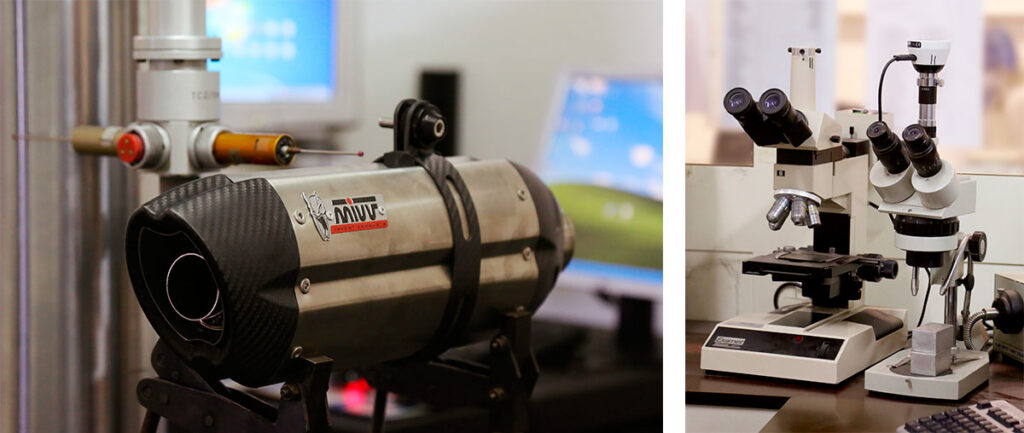
Our company’s goal is to create exhausts with high technological standards. To achieve this, our products must be constantly subjected to inspections in order to obtain maximum performance from them.
The engineers in our Research & Development department can rely on state-of-the-art facilities and equipment, including a semi-anechoic chamber for noise measurements under controlled environmental conditions, as well as several types of engine test benches (an eddy current dynamometer, a rolling road dynamometer, and two dynamic test benches).
The types of tests we carry out include: exhaust system performance, acoustic measurements, and temperature measurements.
Once the motorcycle has been selected for the development of a prototype, it is refined based on the results obtained from experimental tests carried out on the test bench, together with a series of acoustic measurements that allow total noise levels to be calibrated within legal limits without compromising the performance of the exhaust system. Finally, temperature measurements under stress conditions help identify any critical issues that may arise in components subjected to the highest loads.
Design
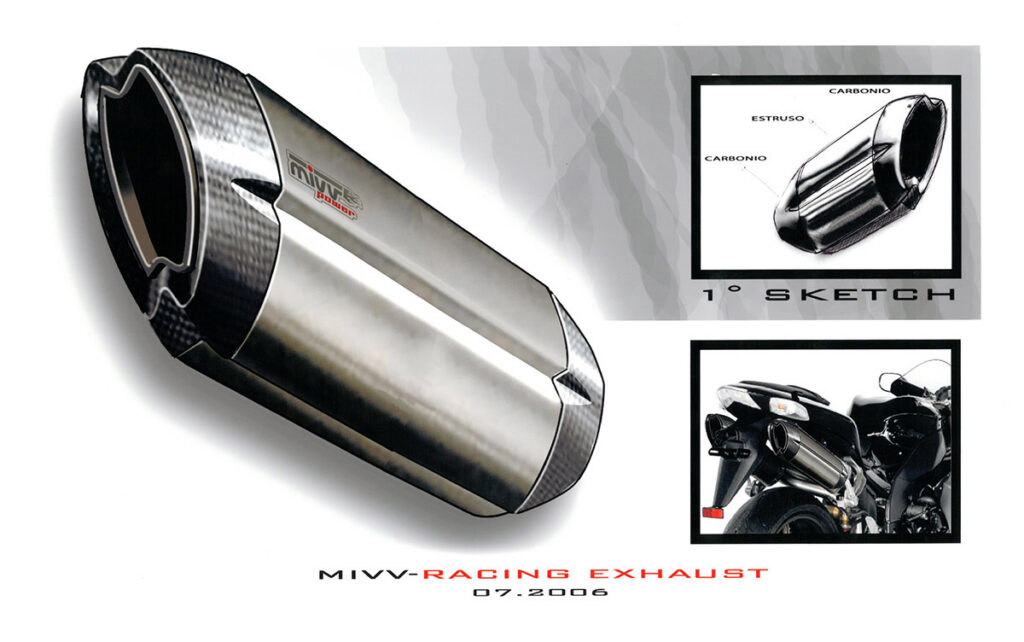
It is our duty to meet the needs of those who love to stand out, even through the appearance of their motorcycle.
The design of our exhausts is therefore a fundamental part of our work, which is why it is developed in collaboration with specialised motorcycle industry designers.
Over the years, many of our innovative design projects have been patented.
Materials
To manufacture our exhausts, we select the finest materials available on the market.
The most technically advanced versions, typically used in professional racing (Full System Titanium), are developed using Grade 1 titanium, a material that offers a 40% weight reduction compared to standard steel. However, at high temperatures, titanium absorbs oxygen, making it brittle and therefore less suitable for the extreme heat generated by engines. For these applications, we use special titanium alloys that limit oxygen absorption and are able to withstand temperatures exceeding 800°C, while retaining all the lightweight advantages of titanium.
The choice of material thickness is also essential, as it directly affects both weight and fatigue resistance. To achieve these characteristics, we have adopted manufacturing technologies that allow us to work with extremely thin wall thicknesses (from 0.6 mm to 1 mm). The carbon fibre used in our exhausts is 3K twill, 200 g/m2, impregnated with special resins capable of withstanding high temperatures. In our pure racing versions, we guarantee heat resistance exceeding 200°C.
Finally, we pay great attention to sound-absorbing materials, which are essential for reducing both noise and heat. We use cartridges made from a combination of fabrics (14-micron CE textured fibre) specifically engineered to reduce noise, particularly at high frequencies, while withstanding extremely high temperatures.